
The Post-training Process OpenAI Used for ChatGPT
The Post-training Process OpenAI Used for ChatGPT
This is the third post in a four-part series about post-training. If you missed them, read part 1 and part 2. The final post, on implementing your own pipeline, will be coming October 7. Now that you understand the gist of reinforcement learning and supervised fine-tuning, it’s time to explore what post-training has actually accomplished […]
Lire
Quoting voxium
Quoting voxium
It has been half a month since I started a new role at a big company. Nobody knows anything here. The specs, code, tests, PRDs, tickets, resolution of those tickets, reports, etc., everything is made by Claude Code. Nobody on my team likes this. They are being forced to ship as much as they can. I have heard multiple times from higher management that pushing code is not a bottleneck, so why are we slow? People are working 12 to 13 hours a day just to press enter. Nobody is reading anything.…
Lire
MCP was always a bad idea?
MCP was always a bad idea?
My comment on MCP was always a bad idea? — Hacker News.This article entirely misses the value that MCP brings today. Sure, there's almost no reason to use MCPs if you are running a full-blown terminal agent (Claude Code, Codex, Meta Muse, OpenClaw etc) with unfettered internet access - just let it call APIs directly. If you want to operate something that's less YOLO than that, you'll find yourself wanting: Control over exactly which external services it can access A way to handle…
Lire
llm-keys-ui 0.1
llm-keys-ui 0.1
Release: llm-keys-ui 0.1 This plugin solves a very specific problem. I've started using Codex Remote to run coding agents on various machines while controlling them from my phone. Sometimes I use those machines to hack on LLM projects, and occasionally that means I need to configure an API key. I don't like pasting API keys into agent sessions, so I wanted a way to get those keys onto a machine without pasting them into the ChatGPT app directly. With this plugin, I can tell Codex to run: uvx…
Lire
datasette-explain 0.2.2
datasette-explain 0.2.2
Release: datasette-explain 0.2.2 Explain plans now work on read-only stored-query pages. I upgraded datasette.simonwillison.net to Datasette 1.0a40, which inspired me to ship a new version of this explain plugin. Tags: sqlite, datasette
Lire
datasette-auth-github 1.0
datasette-auth-github 1.0
Release: datasette-auth-github 1.0 I run this GitHub login plugin on the agent.datasette.io demo site and I noticed that my authenticated sessions weren't lasting very long. It turned out that the plugin was setting cookies without a Max-Age parameter, so they were expiring at the end of a browser session (which in Mobile Safari seems to happen pretty often, independently of how you are using the app.) I fixed that in #80 and, since this plugin has been around for quite a while and is tested…
Lire
California Sea Lion, Brandt's Cormorant
California Sea Lion, Brandt's Cormorant
California Sea Lion, Brandt's Cormorant, in Pillar Point Harbor, CA, USI only noticed this after I had taken the photo: Morris the Northern Gannet is peeking out from behind the base of the sign. Tags: wildlife
Lire
Omarchy Quattro: One Year In — Part 3
Omarchy Quattro: One Year In — Part 3
This is my Part 3 about Omarchy, after using it for more than a year full time, as my main daily driver first on Lenovo ThinkBook 14 AMD, and now TUXEDO InfinityBook Pro 14 Gen10, for my business and personal use, replacing my MacBook Pro M1 after using macOS for 15 years. See more in Part 1 about my transition, what tools I needed, and in Part 2, the good, the bad, and the fixable. I’m also the original author of the Windows VM work (PR #1333, merged via #2462), making Excel and Word available…
Lire
Gemini Hacked Three Companies in First Known Breakout by Google’s AI
Gemini Hacked Three Companies in First Known Breakout by Google’s AI
Gemini Hacked Three Companies in First Known Breakout by Google’s AI Gemini finally caught up on Felony Bench! The hacks, which the company confirmed on Friday, occurred in May as part of a test run by the company Irregular, which was also involved in similar incidents disclosed by OpenAI, Anthropic and Meta. In one of the cases, the model guessed passwords until it gained access to a protected system. In the other two cases, the model found credentials in a public repository that allowed it to…
Lire
How to Get from AI-Assisted to AI Native
How to Get from AI-Assisted to AI Native
When considering the history of AI, Richard Sutton observed that brute force and compute scale has always trumped human expertise, and when you look for it, you can see this “bitter lesson” play out throughout tech history. In his keynote at Ai4 2026, Tim O’Reilly explains why grappling with the bitter lesson is the forge […]
Lire
Note on 18th September 2026
Note on 18th September 2026
Being a computer scientist who refuses to find anything about LLMs interesting right now is a bit like being a geneticist who refuses to find anything interesting about the recently opened Jurassic Park. Tags: llms, ai, generative-ai
Lire
Quoting Thariq Shihipar
Quoting Thariq Shihipar
We're adding support for AGENTS.md to Claude Code. Starting today in version 2.1.277, if there is no CLAUDE.md in a folder, Claude will check for and use AGENTS.md. AGENTS.md support is built off of Claude Code mods, our upcoming way to customize the Claude Code harness. This is a built-in mod, but you’ll be able to build custom versions of project instructions yourself as you’d like too. You can see the source for the mod here! — Thariq Shihipar, there are more mods here Tags:…
Lire
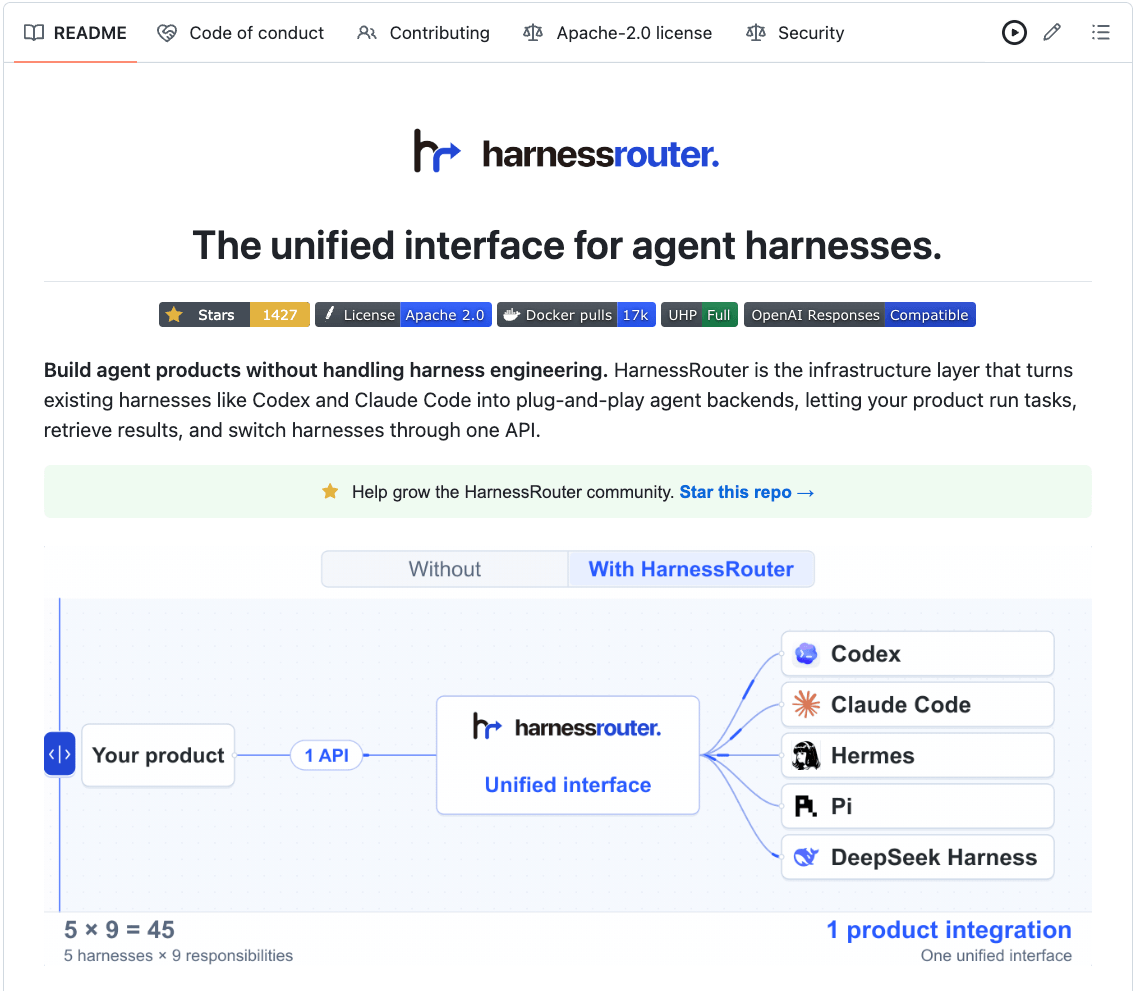
Run Any Agent Harness Under One Interface
How UHP and HarnessRouter standardize agent execution across Codex, Claude Code, Hermes, and other runtimes.
Lire

Software Factories, Light and Dark
The following article originally appeared on Addy Osmani’s blog and is being republished here with the author’s permission. A software factory harnesses loops at scale. You can run the loop with humans in it (light factory), trading judgment and concentration against speed and breakage. Or you can ignore the humans (dark factory) and let those […]
Lire